The Society
Who We Are
A covenant of scholars, researchers, and practitioners bound by a single conviction: that the civilizational record of Alkebulan is the foundation upon which all human knowledge rests.
Origin
The Founding
The Iteru Kem Basilica Society was founded on a recognition that the dominant institutions of Western scholarship had not merely neglected the African civilizational record — they had actively suppressed it. The work of Cheikh Anta Diop, Yosef Ben-Jochannan, John Henrik Clarke, Chancellor Williams, George G.M. James, and Ivan Van Sertima had established beyond serious scholarly dispute that the origins of philosophy, religion, mathematics, architecture, and statecraft lay in Africa, or its true name Alkebulan. Yet this knowledge remained marginal, contested, and deliberately excluded from the curricula of the institutions that claimed to represent human learning.
Iteru Kem was established to correct this. Not through petition, not through protest, but through the patient, rigorous, and uncompromising work of scholarship. The name Iteru Kem — the Black River — is drawn from the ancient Kemetic name for the Nile, the artery of the civilization that gave the world its first organized knowledge. The Basilica designation signals the Society's understanding of itself as a sacred institution: a house of learning in the oldest tradition.
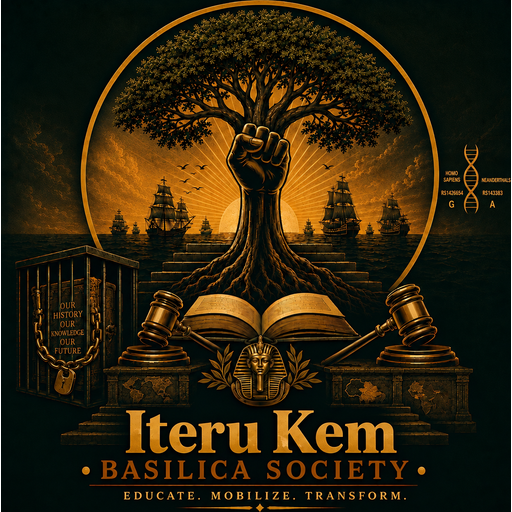
The founding passphrase is inscribed in the Society's seal. It is the dbSNP reference identifier for the single-nucleotide polymorphism most strongly associated with the depigmentation event that accompanied the dispersal of human populations out of Africa. It is what most evidently distinguishes us from them, source from mutation. It is, in the most literal molecular sense, the mark of the departure from the source. Members carry it as a reminder of what was erased — who and what emerged from such erasure — and why we must recover what has been suppressed.
Mission
The Work
Research & Documentation
To produce, collect, and preserve original scholarship on the African origins of world civilization — genetics, archaeology, philosophy, religion, linguistics, and history — and to make that scholarship available to members and the broader public.
Civilizational Theory
To develop and refine the theoretical framework of Civilizable Genesisism — the Society's foundational doctrine that all human civilization traces its genesis to Alkebulan — and to apply that framework to the interpretation of historical, archaeological, and scientific evidence.
Education & Transmission
To transmit the recovered civilizational record to new generations through study, publication, and direct instruction — ensuring that the knowledge suppressed by colonial scholarship is not lost but amplified.
Mobilization & Action
To translate scholarly understanding into civic and political action — supporting the communities most directly descended from the civilizations under study, and working toward the material restoration of what colonialism destroyed.
Structure
Organization
The Society operates as a non-hierarchical covenant of members bound by shared commitment to the mission. There are no ranks, no titles beyond the scholarly, and no gatekeeping beyond the passphrase that marks entry into the Inner Chamber. The Research Committee coordinates scholarly output. The Archive maintains the documentary record. The Mobilization arm coordinates civic action. The United African Legion provides operational security and field propagation. All members have access to all functions.
The Research Division
Coordinates original research, peer review, and the publication of findings in The Archive.
The Archive
Maintains the Society's documentary record — published papers, foundational texts, and the growing catalog of citable scholarship.
The Inner Chamber
The member portal — a secured space for communiqués, resources, and internal coordination accessible to all members.
The Mobilization
Coordinates the Society's institution-building programs, collective provision networks, and community development initiatives.
The United African Legion
Iteru Kem's operational security and propagation arm — protecting members, families, staff, and allies, and assisting in the distribution of the Society's teachings in the field.
Foundational Scholars
Those Who Came Before
The Society stands on the shoulders of the scholars who did the foundational work before this institution existed. Their names are inscribed in the Society's founding charter.
Cheikh Anta Diop
1923–1986Physicist, historian, and the architect of the two-cradle theory. His work established the African origin of Egyptian civilization and the African roots of Greek philosophy on rigorous scientific grounds.
Dr. Yosef A.A. Ben-Jochannan
1918–2015"Dr. Ben" — the most prolific documenter of African civilizational origins of the twentieth century. Author of more than forty works spanning religion, history, archaeology, and philosophy.
John Henrik Clarke
1915–1998Historian, Pan-Africanist, and master teacher. Clarke's synthesis of African world history and his insistence on African agency in the historical record shaped a generation of scholars.
Chancellor Williams
1893–1992Author of The Destruction of Black Civilization — the definitive account of the systematic dismantling of African civilizational structures by external invasion and internal betrayal.
George G.M. James
1893–1954Author of Stolen Legacy — the foundational argument that Greek philosophy was derived from African, specifically Kemetic, mystery systems, and that the attribution of that knowledge to Greece was a deliberate act of theft.
Walter Rodney
1942–1980Historian and political economist. His How Europe Underdeveloped Africa remains the definitive structural account of the relationship between European development and African underdevelopment.
Ivan Van Sertima
1935–2009Linguist and anthropologist. His They Came Before Columbus established the pre-Columbian African presence in the Americas and challenged the Eurocentric narrative of discovery.
Subgroup
The United African Legion
The United African Legion is a specialized subgroup operating under the Society's authority. Its sole objective is to provide operational public and private security services to Iteru Kem members, members' families, administrative and operational staff, and private allies — and to assist in the distribution and propagation of the Society's teachings pursuant to our mission to educate, mobilize, and transform.
The Legion maintains its own operational portal, accessible by separate passphrase issued through internal Society channels. Officers are expected to be students of the Society's teachings — the Legion does not produce shields ignorant of what they protect.
This notice is not for the scholar who reads from a chair. The Legion asks more of its officers than knowledge — it asks the body. Those who stand the post must be capable of sustained physical exertion, endurance under load, and readiness at any hour. If comfort is your standard, seek another path. If you are willing to place yourself between harm and those who carry the knowledge — and if your body is a tool you maintain to that end — then the name of the continent that is the genesis of all things is your key. Seek the portal of the Legion.
Learn More & EnlistMembership
Joining the Society
Membership in the Iteru Kem Basilica Society is not applied for — it is recognized. Those who have found their way to this institution have done so because the work already resonates with what they know to be true. The passphrase is the threshold. Those who carry it are members. There are no dues, no applications, no committees of admission. The covenant is the commitment to the work.
Enter the Inner Chamber"We do not seek a seat at the table that was built from our lumber. We are building a different table entirely."
— Iteru Kem Basilica Society, Founding Charter